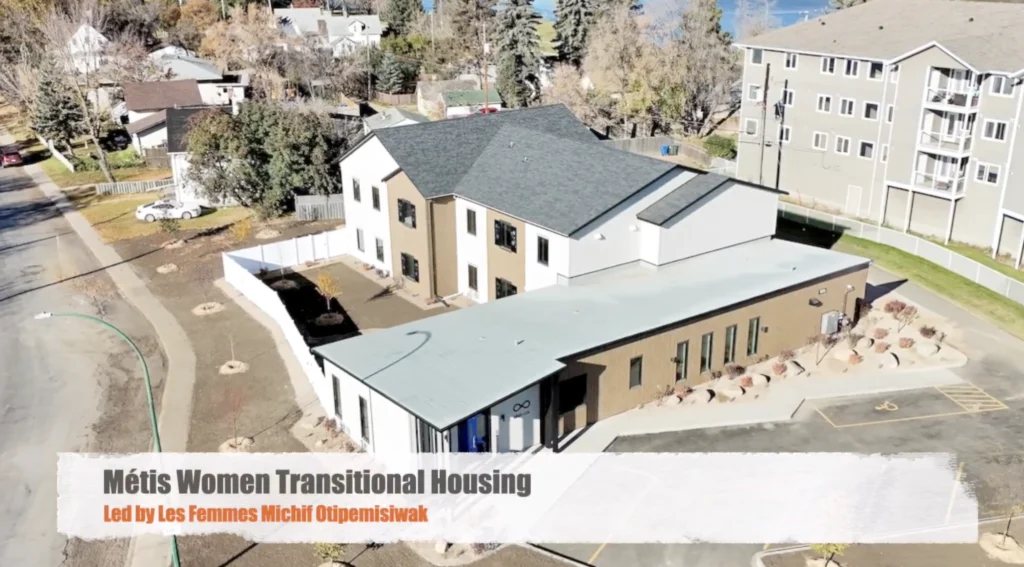
In December 2025, an important milestone was reached in Prince Albert, Saskatchewan. Miakoda, a Métis women’s transitional housing project, officially opened its doors—creating a safe, culturally grounded place for Métis women, 2SLGBTQQIA+people, children, and families rebuilding their lives.
Miakoda did not happen by chance. It is the result of years of advocacy, research, and persistence by Métis women leaders, led by Les Femmes Michif Otipemisiwak (LFMO), working in partnership with Prince Albert Community Housing Society, and supported by federal partners.
“For generations, Métis women have fallen through the cracks of housing and shelter systems that were never designed for us,” said Melanie Omeniho, President of Les Femmes Michif Otipemisiwak. “Miakoda exists because Métis women spoke clearly about what they needed, and LFMO made sure those voices were heard at the decision-making table.”
Across the Métis Motherland, Métis women and gender-diverse people have consistently identified a critical gap in housing and shelter services. Mainstream shelters have often felt unsafe or unwelcoming, while Indigenous shelters located on reserve are frequently inaccessible to Métis women. Too often, women and children were left with impossible choices—returning to unsafe situations or facing homelessness.
LFMO raised these concerns directly with the Government of Canada. When funding opportunities became available through Indigenous Services Canada, LFMO took action to ensure Métis women’s and 2SLGBTQQIA+people’s experiences shaped the response. LFMO conducted a national feasibility study and environmental scan, engaging more than 400 Métis women and gender-diverse people. The message was clear: Métis-specific shelters and transitional housing were urgently needed, and they needed to be culturally grounded, trauma-informed, and designed for long-term stability.
LFMO followed this research with a comprehensive business plan, helping lay the groundwork for Métis women’s housing projects across the country. This work directly supported the funding and development of Miakoda, which became the first operational Métis women’s transitional housing site of its kind.
Miakoda was developed through a partnership between LFMO and Prince Albert Community Housing Society Inc. LFMO provided the leadership, advocacy, research, and system-level support needed to secure funding and move the project forward, while Prince Albert Community Housing purchased the land and now operates the facility. This partnership reflects LFMO’s approach of supporting community-based Métis organizations to deliver services locally, while LFMO works behind the scenes to build sustainable systems and remove structural barriers.
Miakoda offers up to 18 months of transitional housing, recognizing that healing and stability take time. The building includes eight fully furnished two-bedroom units, 24/7 staffing and security, a secure courtyard, children’s spaces, programming areas, and culturally meaningful design elements that reflect Métis identity. Women can arrive with little more than a suitcase and begin rebuilding their lives in a space designed for safety, dignity, and renewal. Six of the eight units are already home to women and children.
Miakoda is more than housing. It is a place of stability and transition, where women are supported throughout their stay and assisted in securing long-term housing before moving on. Early impacts are already visible, with children settling more quickly and families beginning to feel safe and grounded.
Miakoda represents a beginning, not an endpoint. LFMO is now returning to communities to ask what housing is needed next—for youth, Elders, and additional transitional spaces—ensuring Métis women and gender-diverse people continue to lead the direction forward.
“Miakoda shows what is possible when our voices are respected and our solutions are supported. Our hope is that this project opens the door to more Métis women’s shelters and housing across the Métis Motherland, because safety and home should never be out of reach.” said Omeniho